Why Your Coffee Grinder Matters More Than You Think
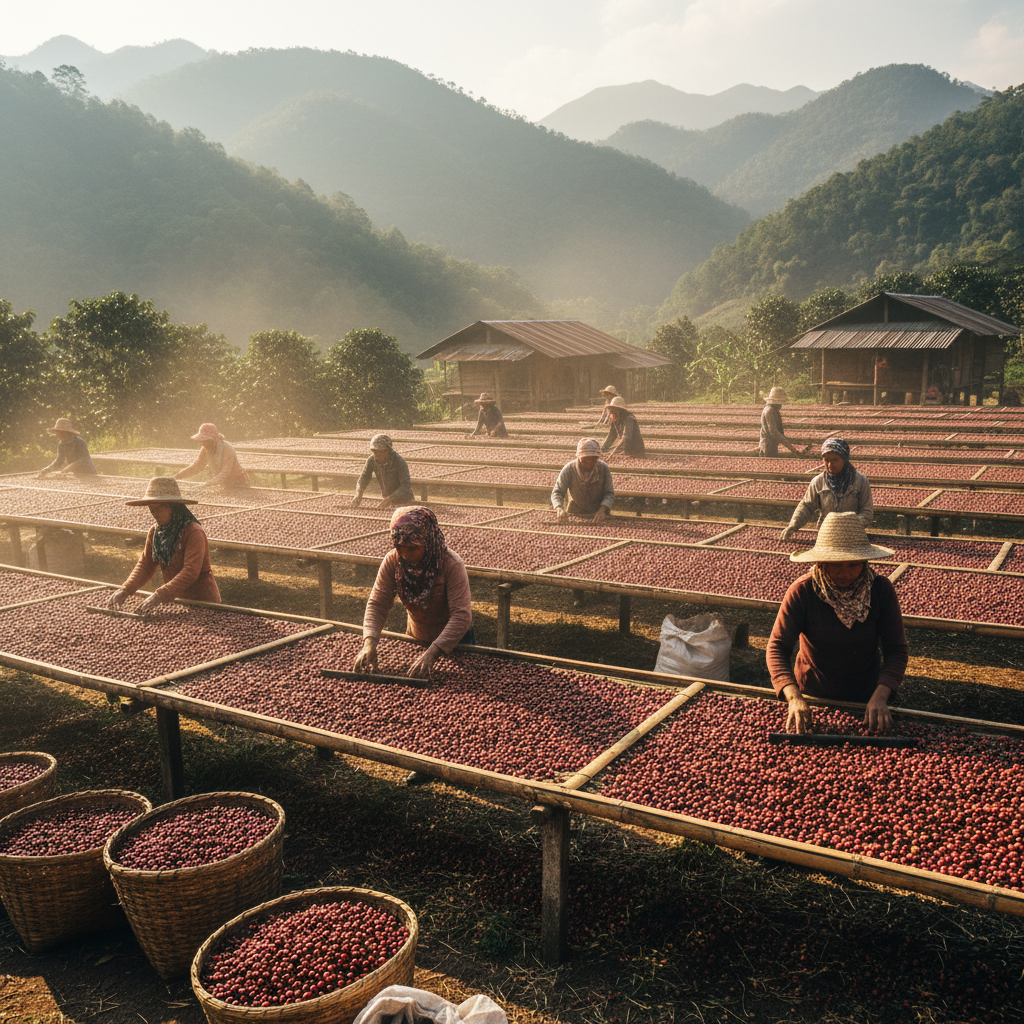
I’ve tasted coffee from over forty countries. I’ve stood in processing mills in Ethiopia watching farmers hand-sort beans with meticulous care. I’ve watched Colombian farmers harvest only the ripest cherries, climbing steep hillsides at dawn to select each one individually.
And you know what breaks my heart? Watching someone grind those carefully cultivated beans in a $20 blade grinder.
It’s like filming a masterpiece on a flip phone. The quality was there – but the equipment destroyed it before it reached your cup.
Here’s the truth: your grinder impacts flavor more than most people realize. Even more than your brewing device. When you understand what is specialty coffee and invest in quality beans, the grinder becomes the gatekeeper between potential and reality.
The Hidden Role of Grinder Consistency in Extraction
Coffee extraction is a balancing act. Water flows through ground coffee, dissolving flavor compounds at different rates based on particle size. Fine particles over-extract quickly, releasing bitter tannins and harsh acids. Large particles under-extract, leaving sour, grassy notes in your cup.
When your grinder produces inconsistent particle sizes – a mix of dust, boulders, and everything in between – you get both problems simultaneously. No amount of technique can fix it.
I learned this firsthand working quality control for a specialty importer. We’d cup the same lot on different grinders. The difference wasn’t subtle. Inconsistent grinding masked origin characteristics entirely. Those delicate floral notes from Ethiopian Yirgacheffe? Gone. The bright citrus from a Kenyan AA? Buried under bitterness.
How Grind Size Affects Flavor in Every Brew Method
Every brewing method demands a specific grind size because extraction time varies dramatically. Espresso contacts water for 25-30 seconds and needs super-fine grounds. French press steeps for 4 minutes and requires coarse, even particles.
But here’s what most people miss: consistency matters more than size. A mediocre grind size with uniform particles beats the “perfect” size with inconsistent distribution every single time.
This is where the burr vs blade coffee grinder debate becomes critical. The mechanism determines whether you can even achieve consistency, regardless of your technique or brewing skill.
Blade Grinders: What You Need to Know
Let’s be fair to blade grinders. They serve a purpose. They’re accessible. When I started my coffee journey twenty years ago, I used one too.
But understanding their limitations helps you make better decisions.
How Blade Grinders Work
A blade grinder uses a propeller-like blade spinning at high speed. Think of a small food processor. The blade chops beans into progressively smaller pieces through repeated impacts.
The problem is physics. Beans nearest the blade get pulverized into dust. Beans at the edges barely get touched. The result? Wildly inconsistent particle sizes no matter how long you grind.
Grinding longer doesn’t fix this – it just creates more dust while some particles remain too large.
The Pros of Blade Grinders
I won’t pretend blade grinders have zero advantages:
- Cost: $20-30 gets you grinding capability
- Compact size: Takes minimal counter space
- Availability: Found in any department store
- Versatility: Can grind spices too (though coffee and spice flavors mixing is another issue)
For someone drinking pre-ground grocery store coffee, a blade grinder represents an upgrade. Fresh-ground coffee, even inconsistently ground, tastes better than pre-ground that’s been oxidizing for weeks.
Why Blade Grinders Fall Short for Specialty Coffee
Once you start exploring single-origin coffee flavor profiles and investing in quality beans, blade grinders become the bottleneck.
Heat buildup is the first problem. High-speed blades generate friction heat that damages volatile aromatic compounds. Those delicate fruity esters you paid extra for? They’re partially degraded before water even touches the grounds.
Inconsistent extraction is the killer though. I’ve cupped the same coffee ground on blade vs burr grinders side-by-side dozens of times. The blade version always tastes muddled and harsh. The clarity disappears. You can’t distinguish individual flavor notes when everything extracts at different rates.
For coarse brewing methods like cold brew or French press, blade grinders work marginally better. But for pour-over, espresso, or anything requiring precision? They’re simply inadequate.
Burr Grinders: The Gold Standard
Walk into any specialty café. Check behind the espresso bar. You’ll see a burr grinder – probably several. This isn’t snobbery. It’s necessity.
When I worked as a buyer evaluating green coffee samples, we used calibrated burr grinders exclusively. Cupping scores depend on consistent extraction. You can’t evaluate a coffee fairly when your grinder introduces variables.
How Burr Grinders Crush Beans Uniformly
Burr grinders use two revolving abrasive surfaces – burrs – with a gap between them. Beans feed through that gap and get crushed at their natural breaking point.
The genius is simple: the gap size determines particle size. Adjust the gap, adjust the grind. Every bean passes through the same space, experiencing the same crushing force.
According to research from Tea & Coffee Lovers: burr materials deep dive, quality burr geometry can produce particle size distributions where 95%+ of grounds fall within the target range. Blade grinders? Maybe 40-50% if you’re lucky.
Flat Burrs vs Conical Burrs Explained
Both work. Both produce quality results. The difference comes down to geometry and application.
Conical burrs feature a cone-shaped burr sitting inside a hollow outer burr. Beans spiral downward through the gap. These dominate the home grinder market – they’re quieter, generate less heat, and work well at lower RPMs.
Flat burrs use two parallel discs with cutting edges. Beans feed between them horizontally. These excel at producing extremely uniform particle distribution, which is why high-end espresso grinders typically use flat burrs.
I use a conical burr grinder at home for filter coffee. It handles everything from Chemex to AeroPress beautifully. When I’m evaluating espresso-roasted samples, I use a flat burr grinder for that extra precision.
Why Consistency Matters for Extraction
Let’s get practical. When you dial in a recipe for specialty coffee brewing methods, you’re controlling variables: dose, water temperature, brew time, ratio.
If grind consistency varies, none of those variables matter. You’re essentially brewing multiple coffees simultaneously – some over-extracted, some under-extracted, some in the sweet spot.
With a quality burr grinder, you eliminate that variable. Your adjustments to other parameters actually produce predictable results. You can replicate good brews. You can troubleshoot bad ones.
That’s the difference between guessing and actually controlling your coffee.
Flat Burrs vs Conical Burrs: Which Type Is Best?
I get asked this constantly. “Should I buy flat or conical?”
The answer depends on what you’re brewing and what you value.
Flat Burr Grinders for Clean, Bright Cups
Flat burrs produce slightly more uniform particle distribution. In the cup, this translates to clarity and brightness. Individual flavor notes stand out distinctly.
For espresso, this matters tremendously. When extraction happens in 25 seconds, even small inconsistencies create channeling – water finds paths of least resistance through the puck, creating uneven extraction.
High-end cafés use flat burr grinders for espresso almost universally. The particle uniformity helps baristas dial in precise recipes and maintain consistency across hundreds of shots daily.
The downside? Flat burrs typically spin faster and generate more heat. They’re also louder and often more expensive at the consumer level.
Conical Burrs for Versatility and Value
Conical burrs create a slightly wider particle distribution – but we’re talking about margins that most people won’t notice in filter coffee.
The advantages are practical: quieter operation, lower heat generation, better bean feeding at coarser settings. For home use, these benefits often outweigh the minor uniformity difference.
I’ve had excellent cups from conical burr grinders. When I’m brewing pour-over at home or making French press on weekend mornings, my conical grinder produces everything I need. The flavor is clean, balanced, and representative of the coffee’s origin characteristics.
Choosing Based on Your Brewing Method
Here’s my practical recommendation:
- Primarily espresso: Invest in flat burrs if budget allows
- Primarily filter methods: Conical burrs offer excellent value
- Mix of both: A quality conical grinder handles both well
- Budget conscious: Conical burrs generally cost less at equivalent quality levels
The burr type matters less than burr quality. A cheap flat burr grinder performs worse than a quality conical.
Burr Materials: Ceramic, Steel, and Durability
This is where grinder companies differentiate themselves. The material science directly impacts grind quality, consistency, and longevity.
How Burr Materials Affect Grind Quality
Burr material determines three critical factors: hardness, heat retention, and wear resistance.
Harder materials maintain their cutting geometry longer. As burrs wear, the gap becomes less precise and particle distribution suffers. Quality materials postpone this degradation for years or decades.
Heat retention affects flavor preservation. During grinding, friction generates heat. Materials with low thermal conductivity dissipate heat better, protecting volatile aromatic compounds.
Ceramic Burrs vs Steel Burrs Comparison
Ceramic burrs excel at heat dissipation. They stay cooler during extended grinding sessions, which matters if you’re grinding for multiple people or back-to-back brews.
Ceramic also offers excellent wear resistance. A quality ceramic burr grinder can last 10-15 years with home use before requiring replacement.
The downside? Ceramic is brittle. A stray stone in your beans (rare but possible) can chip ceramic burrs catastrophically. And cheaper ceramic burrs sometimes lack the precision machining of quality steel.
Tool steel burrs – specifically hardened stainless steel or carbon steel – represent the professional standard. According to Perfect Daily Grind: burr design evolution, modern burr geometry combined with precision-machined tool steel produces the most consistent particle distribution available.
Steel burrs can be sharpened or replaced more easily. They’re more forgiving with foreign objects. And high-end steel burrs feature coatings that reduce heat and extend lifespan.
Heat Retention and Flavor Preservation
I’ve conducted informal tests grinding the same coffee on burrs at different temperatures. Grinding into preheated burrs versus cool burrs produces noticeably different aromatics.
For home use, this rarely becomes an issue. You’re grinding 15-30 grams at a time. Heat doesn’t accumulate enough to matter.
In commercial settings, heat management is critical. That’s why professional grinders feature large burrs (more surface area for heat dissipation) and cooling systems.
The takeaway: both ceramic and quality steel burrs preserve flavor well in home grinders. Focus on burr quality and precision over material type alone.
Manual vs Electric Burr Grinders
This choice comes down to lifestyle more than coffee quality. Both can produce excellent results.
Hand Grinders for Portability and Control
I travel with a hand grinder. Always have, probably always will.
When I’m staying in a small guesthouse in the Colombian coffee region or camping in the Ethiopian highlands, electricity isn’t guaranteed. But I’m still drinking coffee. A hand grinder weighs about as much as a water bottle and requires zero power.
Modern hand grinders produce grind quality that rivals electric models costing 3-4 times more. The burrs are often identical. You’re paying for the motor and convenience with electric grinders.
Hand grinding also offers something intangible – a meditative ritual. Those two minutes of grinding become part of the coffee experience. You’re physically connected to the process.
The downsides are real though. Grinding 36 grams for a large pour-over takes about 2 minutes of steady cranking. Your arm will feel it. And grinding for multiple people gets tedious quickly.
Electric Grinders for Convenience and Speed
My home grinder is electric. On weekday mornings, I want coffee quickly. Push button, receive grounds in 30 seconds. No thought required before caffeine.
Electric grinders shine when you’re brewing for multiple people or making multiple cups daily. The convenience compounds over time.
Quality electric burr grinders also offer features hand grinders can’t: timed dosing, stepped adjustment systems, larger hoppers, and consistently repeatable settings.
The price reflects this. Entry-level electric burr grinders start around $100. Quality models that’ll last a decade run $200-400. Hand grinders offering equivalent grind quality cost $40-80.
Which Is Better for Your Coffee Routine
Ask yourself these questions:
- Do you brew for multiple people regularly? Electric wins for volume.
- Is counter space limited? Hand grinders store in a drawer.
- Do you travel frequently? Hand grinders are portable.
- Is budget tight? Hand grinders offer better value at entry level.
- Do you value ritual? Hand grinding adds tactile engagement.
- Is morning time precious? Electric provides speed.
I own both. That’s actually my recommendation if you’re serious about coffee – start with a quality hand grinder, add an electric later when budget allows.
Grind Size and Consistency: The Extraction Formula
Understanding extraction science transformed my coffee. Suddenly, troubleshooting made sense. Adjustments produced predictable results.
Understanding Particle Size Distribution
No grinder produces perfectly uniform particles. The goal is minimizing the range.
Professional coffee analysis measures particle size distribution in microns. A high-quality burr grinder might produce grounds where 80-90% fall within a 100-micron range. A blade grinder? Maybe 30-40% are in your target range, with huge variance.
That variance matters because extraction rate depends on surface area. Smaller particles have exponentially more surface area per gram. They extract faster and more completely.
When you have both 200-micron particles and 800-micron particles in the same brew, they’re extracting at totally different rates. Some are already over-extracted while others haven’t begun releasing their flavors.
How Over-Extraction and Under-Extraction Occur
Coffee has about 1,800 chemical compounds. They dissolve at different rates during brewing.
Early extraction (0-30% dissolved solids): Bright acids and fruity esters. These taste sour and sharp if isolated.
Middle extraction (30-80% dissolved solids): Sweetness, body, balanced acidity. This is the sweet spot.
Late extraction (80%+ dissolved solids): Bitter tannins, dry astringency, harsh flavors.
Ideal brewing extracts about 18-22% of the coffee’s mass. Too little (under-extraction) tastes sour and thin. Too much (over-extraction) tastes bitter and astringent.
Inconsistent grind size guarantees you’ll get both simultaneously. You can’t avoid it without fixing the grinder.
Fine-Tuning Your Grinder for Perfect Balance
Once you have a quality burr grinder, dialing in becomes intuitive.
Brew tastes sour and bright? Grind finer to increase extraction. More surface area means water extracts compounds faster and more completely.
Brew tastes bitter and harsh? Grind coarser to reduce extraction. Less surface area means water extracts more selectively.
The Honest Coffee Guide grind size reference provides visual comparisons for different brewing methods – a helpful starting point when dialing in new equipment.
With consistent particle distribution, these adjustments work predictably. You’re actually controlling extraction rather than hoping for the best.
Coffee Grinder Selection Guide: Making Your Choice
Let’s get practical. You understand the science. Now, which grinder should you actually buy?
Beginners: Which Grinder to Start With
If you’re currently buying pre-ground coffee or using instant, any fresh grinding is an upgrade. Even a blade grinder improves your coffee immediately.
But if you’re willing to invest $40-50, skip the blade entirely and get an entry-level hand burr grinder. The quality jump is enormous for minimal additional cost.
Hand grinders at this price point offer grind quality that rivals electric grinders costing $150-200. You’re trading convenience for value.
Once you experience the difference burr grinding makes, you’ll understand why coffee people obsess over grinders. The flavor clarity is undeniable.
Specialty Coffee Enthusiasts: Upgrading Your Setup
If you’re already exploring brewing single-origin coffee guide techniques and buying quality beans, your grinder becomes the obvious upgrade priority.
An excellent grinder improves mediocre beans and unlocks exceptional beans. A mediocre grinder limits even the best coffee.
For enthusiasts, I recommend electric burr grinders in the $200-400 range. This tier offers:
- Precision-machined burrs with tight tolerances
- Stepped or stepless grind adjustment
- Low-retention designs (minimal grounds stick in the grinder)
- Durable construction that’ll last 10+ years
- Sufficient adjustment range for all brewing methods
Grinders in this range deliver professional-level grind quality. You’re not leaving flavor on the table.
Budget vs Quality Trade-Offs
Here’s the brutal truth: cheap burr grinders exist, but they often underperform.
A $50 electric burr grinder typically uses lower-quality burrs with wider tolerances. The adjustment mechanism may be imprecise. Build quality suffers. They’re better than blade grinders but not dramatically so.
If budget is tight, I’d rather see you buy a $40 hand burr grinder than a $50 electric burr grinder. The hand version will produce noticeably better results.
Think of grinder investment this way: it’s the piece of equipment that touches every single cup you brew. A $200 grinder used daily for 10 years costs about 5 cents per day. That’s the cheapest coffee upgrade available.
Grinding for Your Favorite Brewing Methods
Different brewing methods demand different grind sizes because contact time varies. Here’s how burr grinders handle the range.
Pour-Over and Chemex: Medium-Fine Consistency
Pour-over and Japanese pour-over technique guide methods need grounds resembling granulated sugar – medium-fine with very consistent particle size.
The brew time runs 2.5-4 minutes depending on your technique. Water flows through the grounds continuously, so particle uniformity directly affects flow rate and extraction evenness.
Burr grinders excel here. You can dial in the exact setting where water flows at your target rate – not too fast (under-extracted) or too slow (over-extracted and bitter).
Blade grinders struggle with pour-over. The dust clogs the filter and slows flow. The boulders let water channel around them. You get both bitter and sour notes simultaneously.
French Press: Coarse and Even
French press needs grounds resembling coarse sea salt. Coarse grind with minimal fines.
Those fine particles are your enemy in French press. They slip through the metal mesh filter, creating sludge in your cup. They also over-extract during the 4-minute steep, adding bitterness.
Quality burr grinders produce clean, coarse grinds with very few fines. The resulting cup is clean-tasting despite the metal filter.
Blade grinders at least work marginally for French press since you want coarse grounds anyway. But you’ll still get significant fines, and your cup will taste muddier than it should.
Espresso: Super-Fine Precision
Espresso is the ultimate grinder test. You need powder-fine grounds with extremely consistent particle distribution.
The margin for error is tiny. Grind slightly too coarse and water rushes through in 15 seconds – sour, thin espresso. Grind slightly too fine and water can’t penetrate – bitter, over-extracted shots.
Espresso-capable grinders feature stepless adjustment or very fine-stepped adjustment. You’re making changes at the micron level.
The MasterClass coffee grind size chart shows the dramatic range grinders need to handle – from French press to espresso is roughly 700 microns to 250 microns.
Don’t even attempt espresso with a blade grinder. It’s physically impossible to achieve the required consistency.
The Cost of Quality: Is a Burr Grinder Worth It?
I’ve justified coffee equipment purchases to skeptical friends countless times. Let me make the case for burr grinders.
Long-Term Investment in Coffee Quality
A $200 burr grinder used daily for 10 years costs 5.5 cents per cup if you brew one cup daily. For two cups daily, that’s 2.7 cents per cup.
Compare that to the flavor improvement. The difference between blade and burr grinding is easily noticeable – even to casual coffee drinkers. We’re talking about dramatically better extraction, clarity, and balance.
Quality grinders also maintain their performance. Burrs last 5-10 years before requiring replacement. Adjustment mechanisms stay precise. You’re not replacing the unit every 2 years like cheap blade grinders.
How Better Extraction Saves Money on Beans
Here’s the math that convinced me to upgrade years ago:
Poor extraction means you’re wasting coffee compounds. You’re paying for flavor you’re not extracting.
If you buy a $16 bag of specialty coffee (12oz / 340g) and achieve 15% extraction with a blade grinder versus 20% extraction with a burr grinder, you’re leaving about 17 grams of extractable flavor in the spent grounds.
That’s roughly $0.80 of wasted coffee per bag. Over a year with one bag monthly, that’s $9.60. Over the 10-year grinder lifespan, that’s $96 – nearly half the grinder cost in wasted coffee alone.
And this assumes you’re buying moderate-quality beans. If you’re investing in exceptional single-origins at $20-30 per bag, the waste compounds further.
When to Upgrade from Blade to Burr
Upgrade as soon as you start caring about coffee quality.
If you’re buying specialty beans – coffee scoring 80+ points, single-origins with tasting notes, beans from specific farms or regions – you need a burr grinder. Period.
Those beans cost $14-20+ per pound because they have distinctive, delicious characteristics. A blade grinder masks those characteristics. You’re paying for quality you can’t taste.
Even if you’re buying decent grocery store beans, burr grinding makes them taste noticeably better. You’ll extract more sweetness, more clarity, more of what the coffee actually offers.
According to testing by America’s Test Kitchen burr grinder reviews, the difference is consistently noticeable even in blind taste tests with non-expert tasters.
The upgrade makes sense financially and flavor-wise. The only question is whether you choose manual or electric based on your lifestyle.
Finding Your Grinding Path Forward
I’ve watched coffee culture evolve over two decades. The explosion of home brewing knowledge, the accessibility of quality equipment, the availability of exceptional beans – we’re in a golden age for coffee enthusiasts.
But none of that potential matters if your grinder is working against you.
The burr vs blade coffee grinder choice isn’t about snobbery or perfectionism. It’s about physics. About extraction science. About whether your equipment reveals or conceals the coffee you’re brewing.
If you’re currently using a blade grinder, I’m not judging – we all start somewhere. But I am telling you that upgrading to even an entry-level burr grinder will transform your coffee immediately and noticeably. You’ll taste clarity you didn’t know was missing.
For those already using burr grinders, understanding the nuances – flat versus conical, manual versus electric, burr materials and geometry – helps you make informed decisions when upgrading or replacing equipment.
Coffee is a journey of continuous small improvements. Better grinder, better water, better technique, better beans – each upgrade compounds with the others.
Your grinder is the foundation. Get that right, and everything else becomes easier. The coffee starts showing you what it’s capable of instead of you fighting equipment limitations.
And that’s when coffee gets really interesting.